
A Hidden Meadow Treasure Foraging for Wild Spinach or Lambsquarters
Did you know one of the most nutritious wild greens may be growing right at your feet? Known as wild spinach or lamb’s quarters, this humble plant thrives in meadows, gardens, and even along roadsides. Its diamond-shaped leaves often carry a soft, whitish coating underneath, and when cooked, they taste remarkably like the spinach you’d buy at the market.
Prolific, abundant, and delicious, wild spinach is the top edible “weed”. It grows with little effort in almost any undisturbed soil and is one of the most nutrient-dense plants ever analyzed. It is rich in potassium and magnesium and has more vitamins A and C, riboflavin, and calcium than domesticated spinach.

In the book, From the Drop of Heaven, Francisca and Catherine went foraging for wild spinach and other wild plants to supplement their diet and as a free source of vitamins and minerals. Today, it’s being rediscovered by foragers, gardeners, and anyone curious about connecting with the land the way our ancestors did.
How to Recognize Wild Spinach
Wild spinach (or Lambsquarters) is a tall, branching plant with triangular or diamond-shaped leaves. The leaves are arranged in a starburst pattern, and vary in shape from narrow and pointed, to rounded and triangular. They may grow up to four feet tall, though they lose flavor as they age. The waxy coating on the leaves makes water bead and deters insects. The edges are slightly toothed, and the underside often carries a whitish, powdery coating that rubs off on your fingers. In summer, clusters of small green flowers rise at the top, giving the plant a feathery crown.
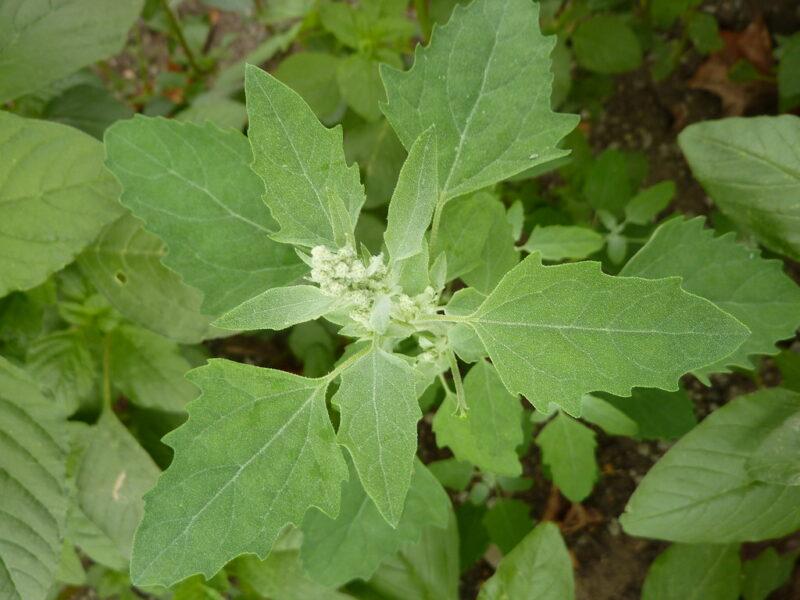
Once you learn to recognize its shape — tall stem, dusty leaves, humble green flowers — you’ll notice it everywhere. In the Middle Ages, villagers would gather it by the basket, boiling or stewing it alongside barley, onions, and herbs. Today, foragers prize it for both its abundance and its flavor.
Foraging for Wild Spinach Safely
Watch out for a poisonous look-alike! The Hairy Nightshade. The leaves on these two plants are similar, but the nightshade is hairy, while the Wild Spinach are not. They are also easily discernable by their flowers. Hairy nightshade flowers are white, while lambsquarters flowers are green and inconspicuous. Another way to identify lambsquarters is to spray the leaves with water and look for droplets.
When foraging for wild spinach, always be sure of your identification. Reminder:
- Look for the dusty white coating on the underside of the leaves — one of the plant’s most reliable features.
- Harvest from clean meadows or gardens, not roadsides where soil may be contaminated.
- Pick the tender young leaves for the best flavor.
A Taste of the Past
Cooked, wild spinach tastes remarkably like the cultivated spinach in your kitchen, but with a richer, earthier flavor. Its leaves are packed with vitamins A, C, and K, calcium, iron, and protein — a nutrient-dense food source freely offered by the land.
In history, it was never wasted. Rural families turned to it when gardens failed, and herbalists praised it as a gentle cleanser for the body. Even now, in parts of the world, lamb’s quarters remain a staple green.
How to Use It
Wild spinach is versatile in the kitchen. Wash well before cooking
- Sauté it with garlic and butter as a side dish.
- Stir it into soups or stews, as peasants once did.
- Blend it into omelets or quiches for a hearty meal.
- Dry the leaves for use as a mild green powder to sprinkle into bread or broth.
Its seeds, too, can be ground into flour — an ancient practice in lean years when nothing else could be spared.
Why Forage?
Foraging for wild spinach isn’t only about food. It’s about connection — with the land, with history, and with the resourcefulness of those who lived before us. Each plant tells a story: of survival, of resilience, of nourishment freely given. To walk through a meadow and recognize lamb’s quarters where others see weeds is to step into that story and carry it forward.
A Final Word
Wild spinach is one of the simplest and most rewarding plants to forage. Abundant, safe to eat, and rich in nutrients, it has been a companion to humankind for centuries. Next time you walk through a meadow, look closer. The humble plant at your feet may be the same green that once simmered in the pots of our ancestors.
Harvesting: Thin the patch by pinching shoots close to the ground and placing the baby shoots in a bowl of water to keep them from drying out. Harvest larger plants by pinching the upper stem. If the stem pinches off easily, it is tender enough to eat. If the stem is old and woody, pluck only the leaves, though pruning the woody stem will stimulate new growth. If the leaves are too old, they may become bitter but are still usable cooked with onion, garlic, or in a stew.
Source: Kallas, John. Edible Wild Plants, Wild Foods from Dirt to Plate. Gibbs Smith Publishing (2010) Print