Juliette’s Blog is the place where stories stretch their legs. Where history breathes through half-forgotten remedies, backroads research trips, curious old texts, and the quiet beauty of everyday discovery.
Whether you’re here for behind-the-scenes glimpses into the making of From the Drop of Heaven, inspiration for your own creative projects, or simply to wander the Vosges with me from the comfort of your screen—you’re in the right place.
Each post is a small window into the world behind the book: research adventures, book club extras, ancestral oddities, and the deep well of historical detail that shaped the story. You’ll also find updates, event news, and musings on everything from vintage font choices to foraging in forgotten forests.
Juliette’s blog is also an invitation—to slow down, to follow the thread of a question, to get curious about the past and how it still hums beneath the surface of things. You don’t need to be a historian or a writer to belong here. Just bring your sense of wonder.
Because while centuries have come and gone, people haven’t really changed. We still ache, love, hide things, seek answers, and wrestle with what’s right. We still fear for our children and hope for something better. If you listen closely enough, the voices from the past don’t sound so different from our own.
Thanks for stopping by. I hope you find something here that stays with you.
I am reposting a photo of my first award, the Royal Palm Literary Award because it is pretty and because I truly believe that without it, I wouldn’t have gotten a contract from Sunbury Press.
Using a genealogical search as part of a plotline has always been a fascinating topic to me. Recently I met Juliette Godot on Twitter and asked if she’d mind letting me pick her thoughts a bit on the subject.
Use Buried Truths in Your Next Bestseller. Here’s Juliette’s genealogy story.
I have a weird name that kids picked on and I hated it, so when I got older I wanted to do my genealogy to see if I was related to someone famous – LOL. I have been working on my family for about 10 years now and have over 35,000 names in my tree. Some, dating back to the 1400s. Two saints, two witches, one guy who was beheaded for incest, and rumor has it, my Crispin ancestor was the Crispin that accompanied William the Conqueror in the 1066 Norman invasion of Britain. Possibly even Silas Crispin, born in 1655, the guy who negotiated the treaty with the Indians for William Penn in Penns Woods might be my 7th-generation grandfather.
Anyway, after I found my link to France and entered people on my tree, I started getting messages from people in France who were very distantly related. Most of the time, we talk for a while, several times a week for a couple of months, and then we lose touch. So one day, I received a message from Francoise Cordier, a distant cousin who asked if I know about a particular person who was married in 1585. I knew the name, but nothing more, and I said “No, I’m in the US and the only information I get is on the computer, but if you find out anything, please let me know.” I’ve said that dozens of times and I have never heard anything else.
Well, a couple of weeks later Francoise emailed me that she couldn’t find anything. I was not surprised. Once you get back that far, the records are very sparse. For some reason, out of the blue, I said, “Well, then we can make it up and write a book.” I was just joking, but it turns out that Francoise is a retired journalist who had always thought about writing a book! So we started bouncing ideas off each other. We both had different visions for the book and we wrote our own versions, but the family is, of course, the same. She self-published hers in French. It’s called Les Demons du Pays de Salm, but since I wrote so much more, and had never written anything before, it took me much longer, and I just now finished with mine.
I had never met Francoise face-to-face until I traveled to France. She escorted my husband and I all around the old country of Salm and showed us all the places mentioned in the book. Now Francoise and I are great friends and email at least once a week for about three years now, so there are many advantages in learning about your past – finding true friends.
Fiona – How fun is that?
Now, if you were a character in a novel who decided to follow along your real-life experience, how would she begin?
Juliette – You start at the obvious beginning, ask everyone for as much information as you can get, and then take it all with a grain of salt. Sometimes, people know what the family wants them to know and there are always skeletons in the closet that nobody knows about.
It is the skeletons that make a good book, of course, but you don’t want everyone in the family to hate you either
So I would go back far enough that nobody would be embarrassed by what you find. In my case, I went back to 1585.
Fiona – It sounds like an amazing way to twist a plot – especially when you said that there are things that a family edit in the retelling. Can you give us some examples?
Juliette – For example, in the past babies were born “premature” a lot. I don’t know if that makes for a good book, though. I know the infant mortality rate was high in the past, but sometimes I wonder about every child dying… No proof there.
A lot of times babies were given away or people pretended they actually had a baby later in life, when really, the child was their grandchild. I had one ancestor who was convicted of incestuous relationships. He was the mayor of the town. The paperwork I found said the women were paraded out of town and were not allowed to return. The mayor was beheaded.
So you have to wonder, was it a set up? or was he really a pedophile?
So you could start from there and write the book either way because history does not tell you.
Fiona – Where would an intrepid heroine go to start culling through the genealogical data are there sites you suggest? And what kind of documentation can you find on these site?
Juliette –
Like I said, talk with your ancestors who are still alive.
Most libraries have genealogical departments storing obituaries, that’s where I went next.
Then the local courthouse for census records.
It took a while for me to finally get across the pond to France, and I actually got the information by luck.
I knew my great-grandfather worked at a glass factory in France, but my grandfather said he came from Nancy. There was no record of him in Nancy. Somehow, I happened to get a copy of the employee roster from a local closed glass plant. It turns out that someone from the plant went to France and recruited glaziers, my great-grandfather was one of them. On the roster, everyone was supposed to record their hometown. None of the men did, except my great-grandfather, and I found he was actually from Harbouey, not Nancy.
Once I found relatives from Harbouey , I joined geneanet.org which is based in France.
For someone who is just starting out, I would say try all the free sites first. The biggest free site is familysearch.org, run by the Mormon church. You can find a lot of information there, but there are other free sites. usgenweb.org, findagrave.com, there are also many genealogy family pages on Facebook, so search there too.
Fiona – So it seems a real boots on the ground adventure and less Ancestry.com searching…which makes for a more interesting plot anyway.
Are there rule for gaining access to public records?
Juliette – Well, Ancestry is expensive, about double what Geneanet costs. I would do as much free as I could first before spending money.
Rules? Yes. Some churches may give out information but only 100-year-old information, and they are not very accommodating. For me, I would have to drive to the diocese in Pittsburgh and look there because the local churches do not keep records. Libraries have old newspapers, but you almost have to know what day an event occurred to be able to find it.
Europeans seem to be much more interested in their genealogy, at least that’s what I have found, so you really need to join a site over there to get the most information.
I just happened to be adding people from someone else’s tree and they had it in the notes about the ancestor who committed incest. That’s how I found out about my protagonist, too. One of my relatives over there asked me if I knew what had happened to her, and she told me.
Fiona – So can you list some records that would be available? I’ll start: birth records, marriage, death certificates… what about medical records? school records…?
Juliette – I have never found any medical records or school records. The census is a good place to get names, but once you get to the birthplace, unless you live there, it’s hard to get records, though you can order them online and pay for someone to look them up for you. That’s why I joined Geneanet. I am really only familiar with them because my ancestors are from France, which is where Geneanet is based, though they have most of Western Europe in their database.
Fiona – You mentioned pay. If you were trying to do a thorough search of someone’s history can you tell me about budgeting that – there is the European vacation … but say here in the States, how much money would it take to do this?
Juliette – It depends on the era. If it is recent, you can find a lot of information at the library. They have archived newspapers, and obits. The courthouse has the census and deeds.
Getting copies of birth certificates – from Geneanet, you used to be able to buy a pack of points and each record, depending upon how hard it was to find cost so many points.
In total, besides my trip that was a great vacation, I probably don’t have more than $500 in my whole tree.
The first thing you need to buy is software. I have Family Tree Maker, but there are others. Don’t try to just use excel or something, I tried because I’m cheap, but it was just too much of a headache. The software is worth the money.
It is not an expensive hobby if you are willing to spend the time doing it. If you want to find people fast, then join Ancestry.com and pay.
Here’s another good free site. http://www.cyndislist.com/ More than 327,000 links! 325,000+ links, categorized & cross-referenced, in over 190 categories. Another 1790 uncategorized new links in the works.
Fiona – As a history major this kind of thing is fascinating to me – I think it could lead to all kinds of plots.
Juliette – I had never even thought to write a book until I found my protagonist.
Fiona – Can you fill in a little about your protagonist? Which parts are factual which did you create in your imagination?
Juliette – Her death is historical fact. The time and place were very thoroughly researched. We know the politics of the area, the religious wars were going on. We know what was going on all around them.
Fiona – Which era? What country?
Juliette – The country is Salm – It was swallowed up by Lorraine and then later, Lorraine was swallowed up by France, then Germany, then back to France, but the era of my book is when it was still Salm.
Salm was a small country caught in between Lorraine – Catholic, France – Catholic, though Henry of Navarre was Protestant, and Germany, which was part of the Catholic Holy Roman Empire, but it was Protestant. This was during the Renaissance. The Protestants were making a lot of noise and upsetting the Catholics. Salm was actually Independent, which was another fascinating aspect of this era. It was run by 2 Counts, one Catholic, one Protestant. It was about the only place in the area where you weren’t persecuted because of your religion.
This is when Mary Queen of Scots was in jail, Elizabeth was Queen of England, and Henry of Navarre was King of France.
I didn’t know any of this before we started researching, but it really made for an interesting backdrop.
Fiona – Absolutely!
Juliette – So I think in order to write a historical, you really have to look in to the politics of the day.
When a character looks at her tree, though, she doesn’t really need something horrific. Sometimes, there were entire families – 10 kids, and none of them lived. Were they just unlucky, sickly, or maybe something more sinister? If you go back far enough not to offend anyone, you could use your imagination.
If you know the history of the era, you could probably find out if there was an influenza outbreak or something like that could have wiped out the family, or could it have been a wild animal, roving bands of thieves, maybe a crazy person randomly murdering people.
Fiona – I always thought it would be cool to go to Ellis Island and see my ancestors’ names in the books.
Juliette – Yes, actually, Ellis Island has a free site. They ask for donations.
I’ve never gone there, but I do have a copy of the ships registry where one grandmother and her 6 kids names’ are listed.
Fiona – Looking into the past does seeing these records of times and people past ever just — I don’t know make you feel very mortal and wonder what future generations will find when they look you up?
I’m wondering about the character reactions to seeing their records.
Juliette – Well, they certainly will have more to read than in the past. Most of the people in times gone by could not read or write so it was up to the church to keep the records. History is always written by the winners, too, so you never know how accurate it really is.
Fiona – A thrillWriting traditional question is – would you share a scar story or your favorite harrowing story?
Juliette – I don’t really have any scars, and I’ve never been in any harrowing situations.
We did have a funny experience in France.
After we left Francoise, we spent a couple days in Paris. We wanted to do everything French, including eating Frog Legs. So one day we were going down to the subway and an older gentleman stopped us and said the train was not working and they had told him it would be at least half an hour. The man was very kind and we started talking to him about our trip. I mentioned that I wanted to eat Frog Legs and he said to come with him, he was on his way back to work and we would get off at his bus stop where we could get the Frog Legs. So we followed him on the bus. We rode for a very long time – I started getting nervous. I didn’t know this guy at all. Where was he taking us? So finally we got off the bus and he pointed down the street at a very small shop and said we could get our Fried Eggs (!) down there… LOL! Fried Eggs! We had no idea where we were, we didn’t speak French and he just smiled and waved and left, so there we were. We walked around a bit before we found a restaurant – they didn’t have Frog Legs, I don’t know if they had Fried Eggs :-). I got Lapin (Rabbit) it was very good, and luckily we found someone who spoke English who pointed us to the subway, and we were able to find our way back.
Thank you so much for stopping by. And thank you for your support. Cheers, When you buy my books, you make it possible for me to continue to bring you helpful articles and keep ThrillWriting free and accessible to all.
From the Drop of Heaven is available from Beacon Audiobooks!
I am pleased to announce From the Drop of Heavenhas been produced by Beacon Audiobooks and is now available on Audible and other streaming venues.
With an audible membership, it is only $.99. Switch between reading the Kindle book and listening to the Audible audiobook with Whispersync for Voice. Get the Audible audiobook for the reduced price of $7.49 after you buy the Kindle book. You can also sign up for a free 30-day trial of Audible and listen for free.
Beacon Audiobooks, a New York City-based production company, specializes in the narration and distribution of audiobooks throughout the world. Their productions are distributed to all major retail outlets, including public libraries, universities, colleges, high schools, and more.
David Cantor nailed the audio. With the setting in Alsace-Lorraine and Francisca coming from Spain, French, German, and Spanish accents were frequent in the text and were handled very well by the narrator.
I recently was invited to talk about my book on the Sunbury Press Book Show on the #BookSpeakNetwork Podcast. I am not an accomplished public speaker, so I was very nervous. I know the reason.
As a Yinzer from the hills around the Pittsburgh, Pennsylvania area, I catch myself saying regional words that might be confusing to those who don’t live here. You can take the girl out of the country, but you can’t take the country out of the girl.
For example: I remember when I was in grade school. The word CHIMNEY was on my third-grade spelling list. I had never heard of a chimney, though I had often heard the word CHIMLEY. LOL. So I learned the “right way” to say and spell the word.
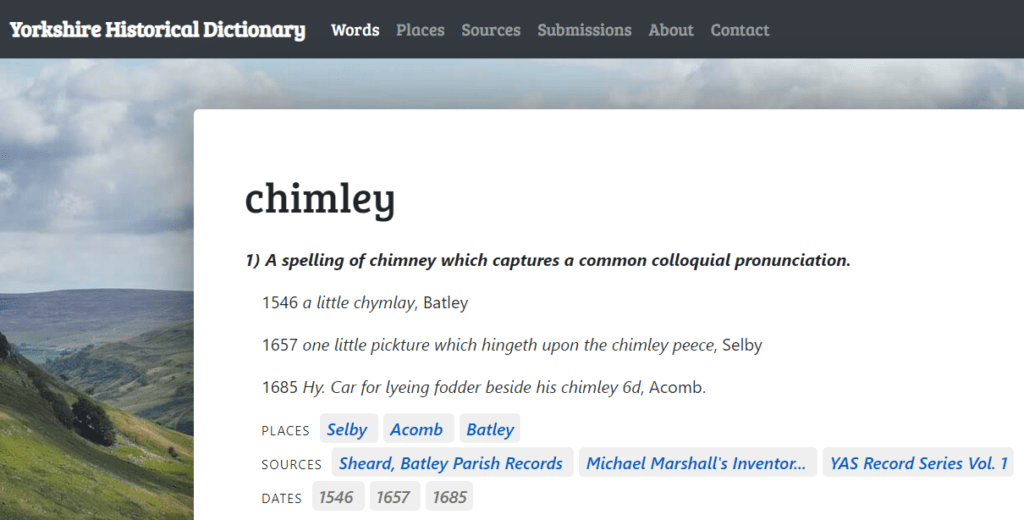
But where did the word chimley come from, and why do they say it in my neck of the woods? There are many instances of the word coming from Scotland and Northern England, but my ancestors are from France and Germany. I’ve searched for references, but could find nothing.
Yorkshire Dictionary
Other sources of the word chimley
Here are some sources found on the Ulster-Scotts Academy website:
chimbley, chimleyn A chimney. [oed chimbley, chimley n Scottish and dialect; dost chimlay n 1540→; snd chimbley, chimley n; dare chimbley n A chiefly South, Midland]
1829 McSparran Irish Legend 294 Out of the chimley she goes like a wild goose.
1880 Patterson Antrim/Down Glossary 18 chimley = a chimney.
1886 Lyttle Ballycuddy 43 They put anither big sod on the chimley so as nae licht cud get in.
1928 McKay Oul’ Town 64 His next move was to pelt stones down widow Rooney’s ‘chimbley’, an’ if he didn’t break her teapot.
1981 Pepper Ulster-English Dict 18 That’s the second time this week the chimley’s went on fire.
1939 Hall Coll Boys, you’uns [are] talkin’ about rough country, but I’m going to tell you one time the roughest country I was in. It was so steep the people had to look up the chimley to see if the cows was still in the pasture.
1969GSMNP-38:62 They had it about all finished except the chimbley.
So, you see, chimley is not a made up word spoke by unintelligent hill folk. It has a very long history and is perfectly fine to say. I try not to say it simply because it is ancient and has fallen out of favor, though one day at Carnegie Mellon University, it slipped out. Old habits die hard. I just laughed, and called myself a hick. One colleague from Italy didn’t know the word hick either. I confused him completely.
But what does this have to do with the #BookSpeakNetwork Podcast?
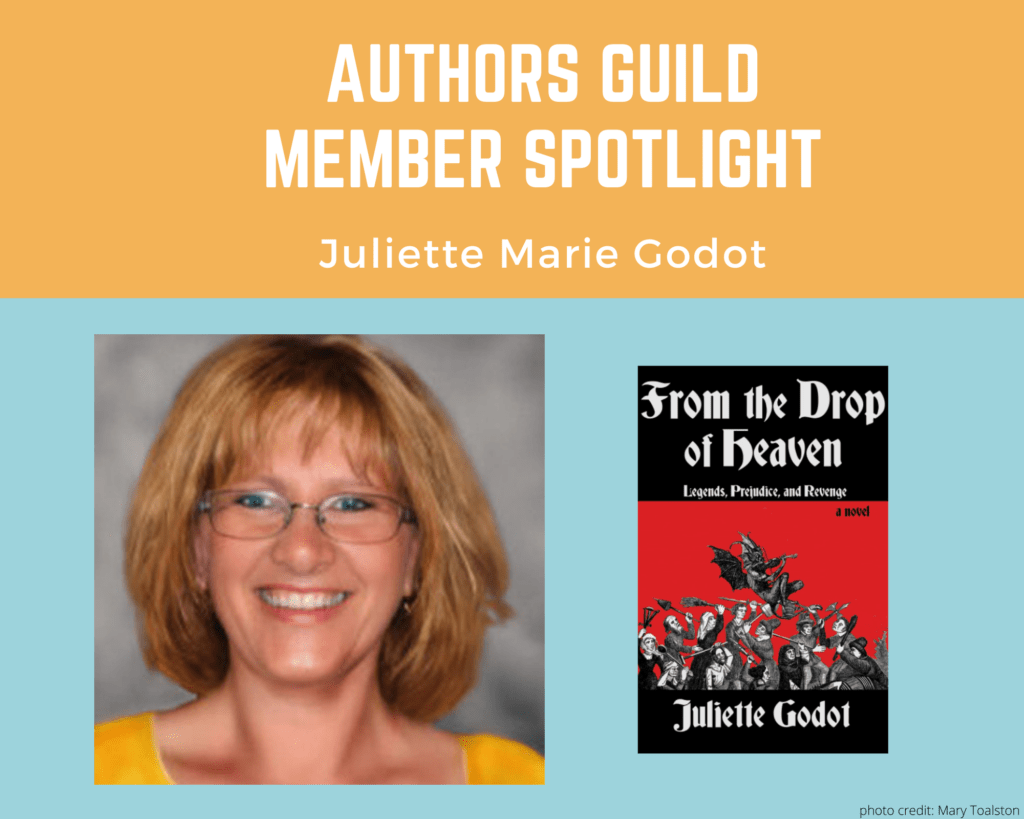
Juliette Godot in the Authors Guild Member Spotlight
Why is writing important to you and why do you think it’s an important medium for the world?
Writing is important to the world because it allows the writer’s experiences, ideas, and dreams to be understood and contemplated by others who would never have met that person and would never have had the chance to see the world through another’s eyes.
What are your tried and tested remedies to cure writer’s block?
My tried and tested remedy to cure writer’s block is to read something. Something as mundane as the local news or a magazine article could trigger the perfect idea. Always keep your mind open to any reading opportunity.
What is your favorite time to write?
My favorite time to write is in the evening. I got a lot of my ideas on my long commute home. As soon as I arrived, I had to quickly get them written down before I forgot them.
What’s the best piece of writing advice you’ve ever received and would like to impart to other writers?
The best piece of writing advice I’ve ever received and would like to impart to others is to get beta readers that are not your friends or family. Friends and family won’t tell you the truth. They mean well and since they know you personally, they may also know the situation you are describing. You need someone completely impartial to give you honest feedback.
What excites you most about being a writer in today’s age?
What excites me most about being a writer today is that research is so much easier. We have access to most of the world’s history at our fingertips. Within a few minutes, I can search for every historical event that happened on a certain day, hundreds of years ago. As someone who was born prior to the rise of the internet, I remember having to search my family’s encyclopedias (back then, every family had a set of encyclopedias) to find information for a school paper. Now, I can find that information in an instant.
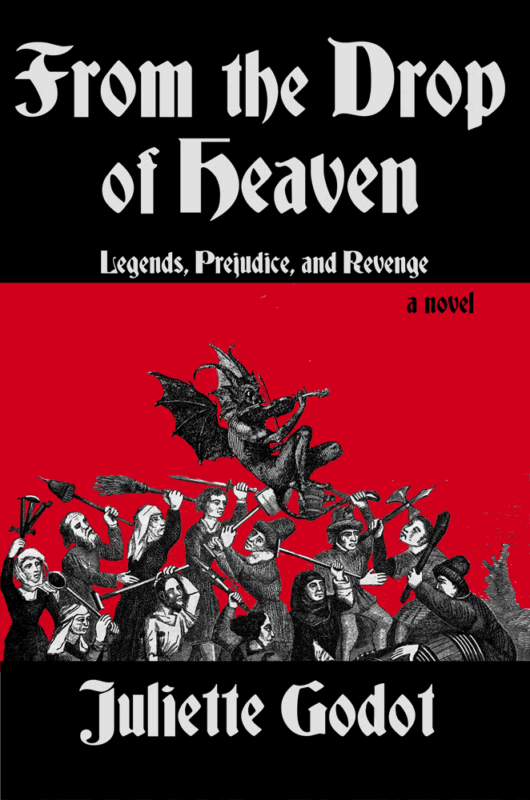
Juliette Godot’s From the Drop of Heaven is out now with Brown Posey Press.
Find out more about me and my research for the novel, From the Drop of Heaven.
It’s 1582. A time when books are banned, and witches live next door. Citizens of the European principality of Salm pray the way they want. While Catholic and Protestant fanatics in surrounding towns believe theirs is the only truth. Everyone is a heretic to one side or the other.
Banned books in tow, Martin, an accused seditionist, seeks safety in Salm. He teaches Nicolas, the mayor’s son, to read. Though Nicolas knows Martin’s books are banned, he cannot resist them.
Catherine Cathillon and her family live in isolation. Though Catholic, her father’s mistrust of the church prevents her from joining the community. However, a chance meeting with Nicolas changes everything. He reads to Catherine. When she learns what life is like outside their farm, she begs him to teach her to read. But class differences force them to meet in secret. During the lessons, they fall in love, but their romance is exposed, and spurned lovers swear revenge.
Lovelorn vengeance is one thing, but when someone finds one of the banned books in Nicolas’s shop, Catherine realizes that her father was right. Their true enemy is the man charged with saving their souls. Nevertheless, he will stop at nothing to reinforce his position of power.
Genealogist Juliette Godot draws upon her own Renaissance-era family to bring you her award-winning debut novel.
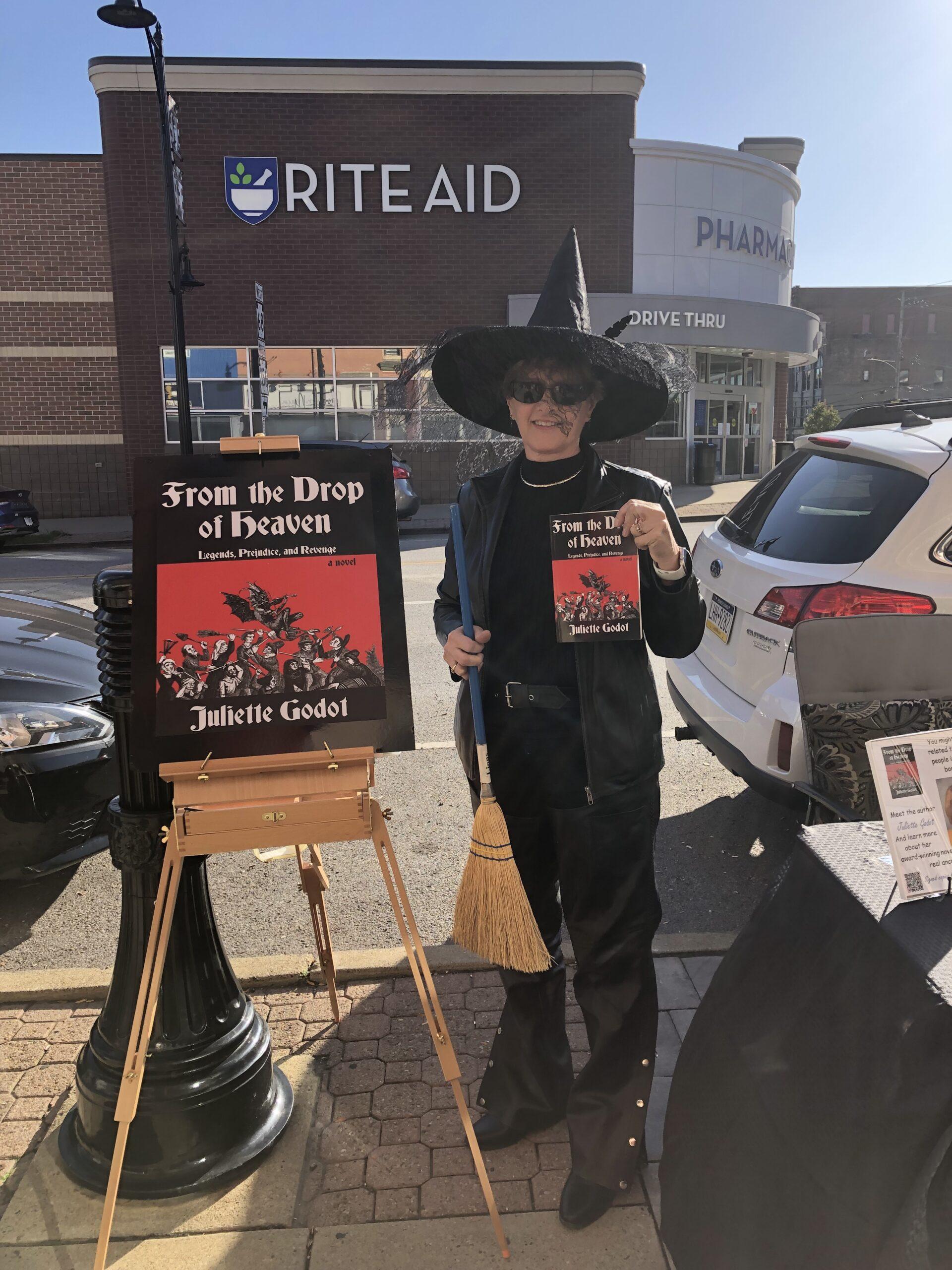
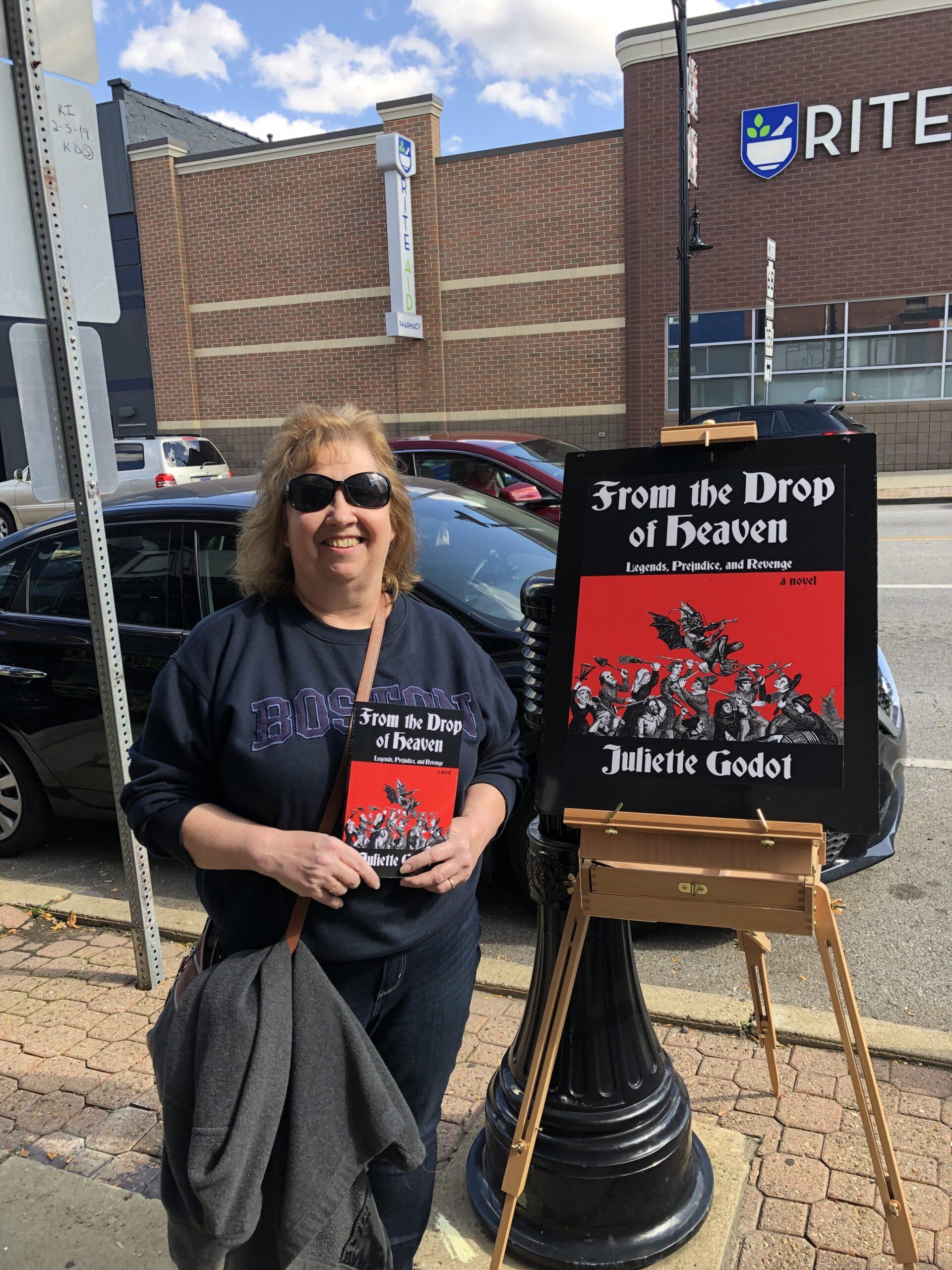
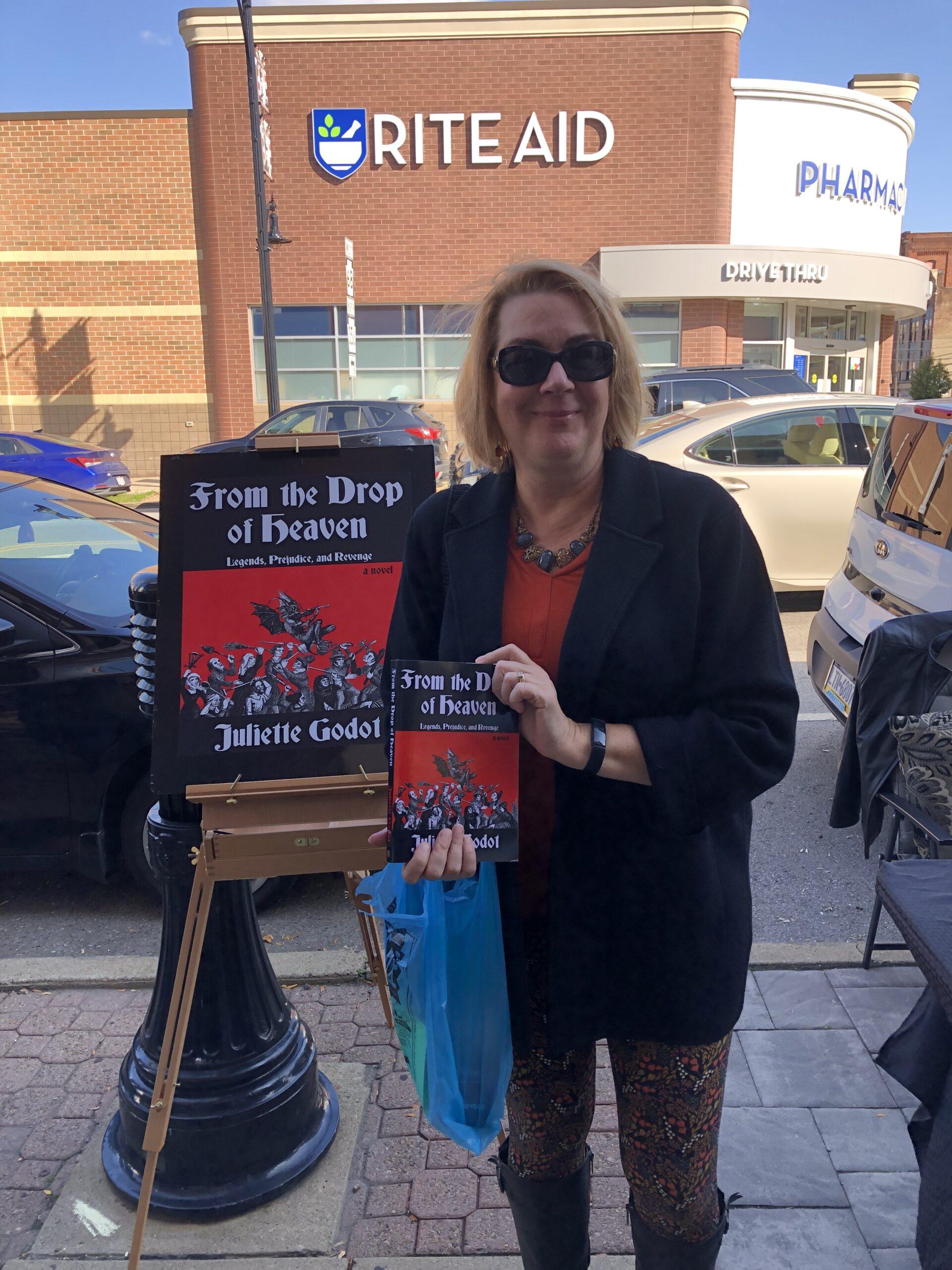
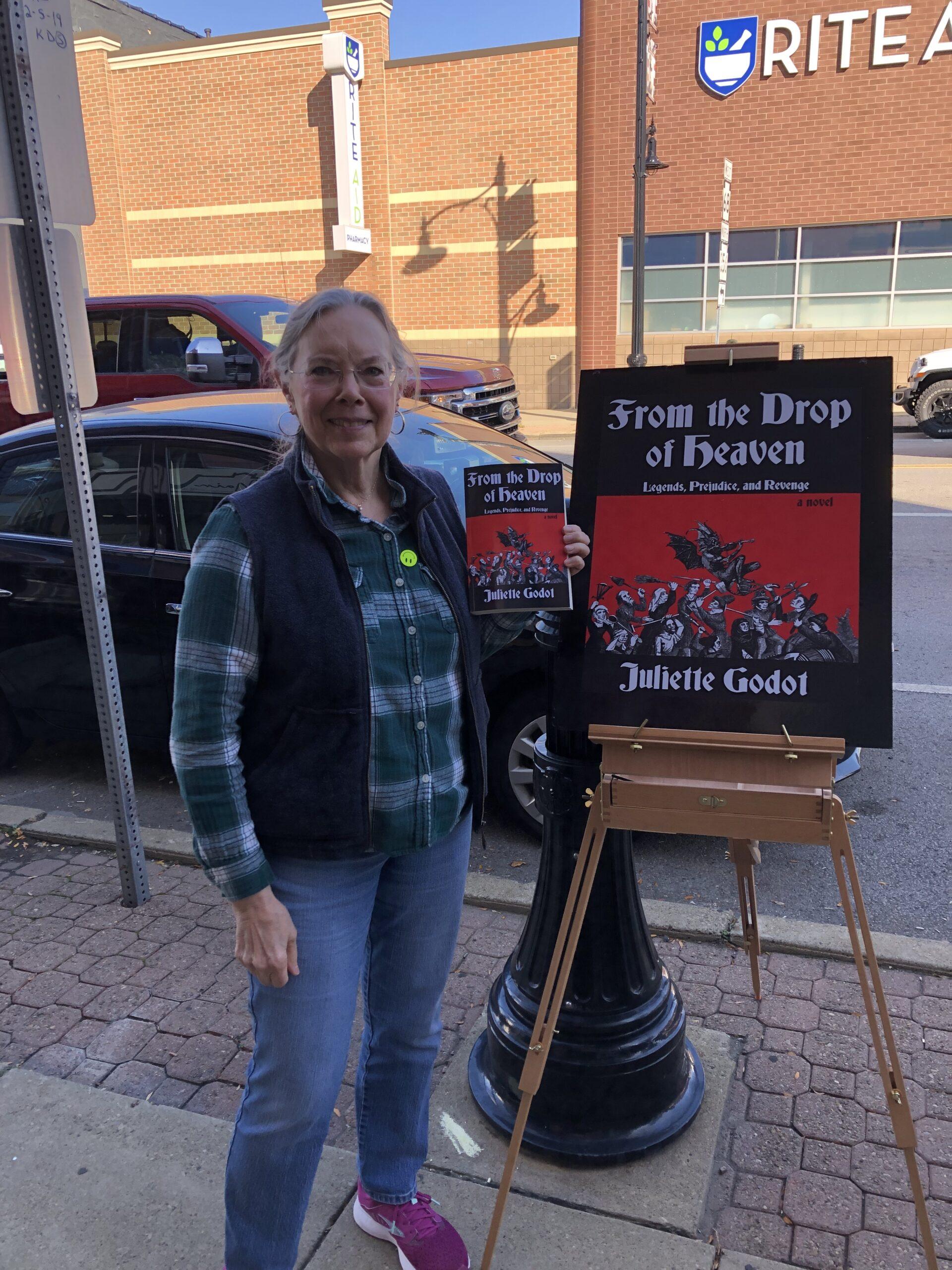
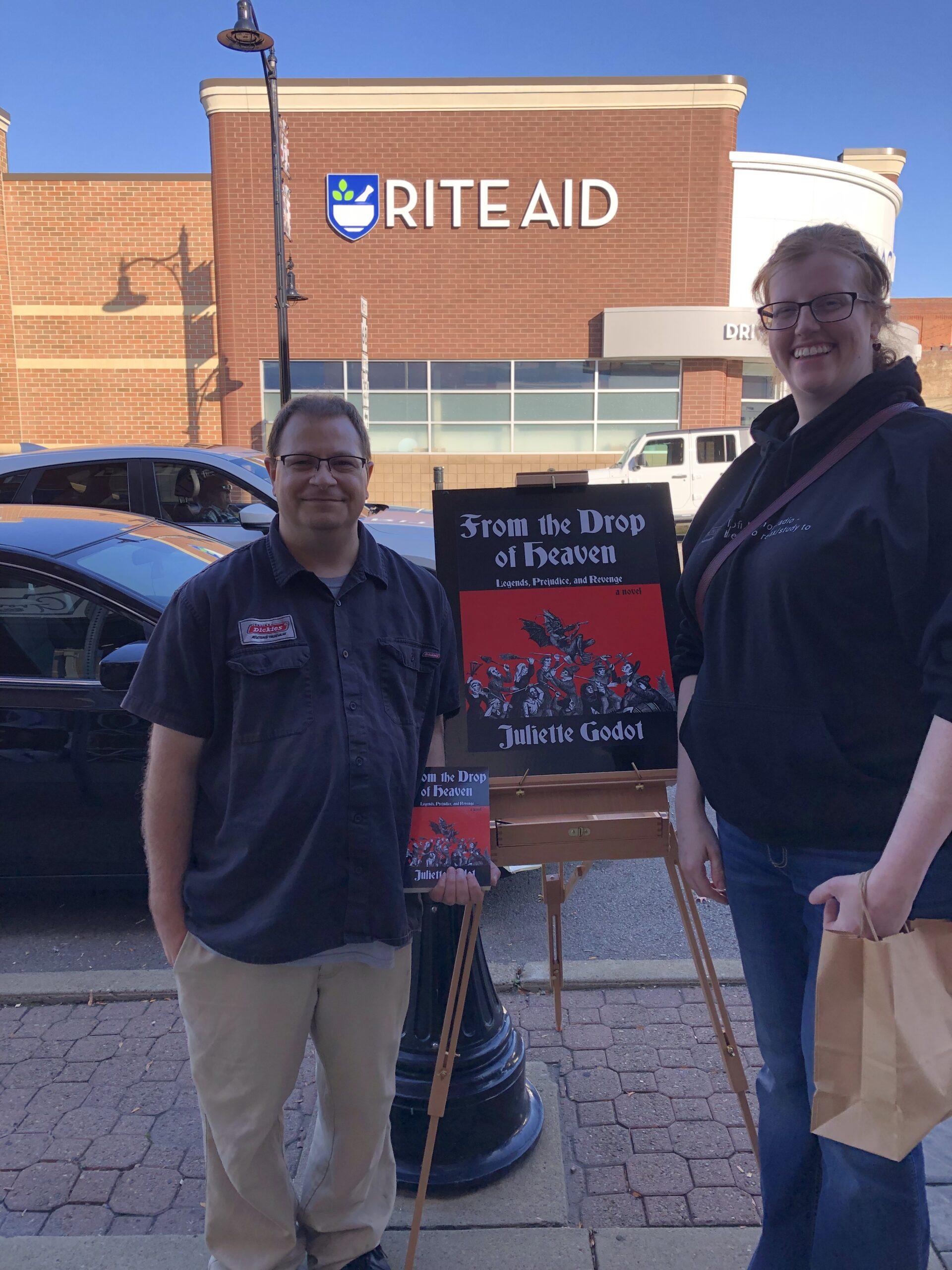
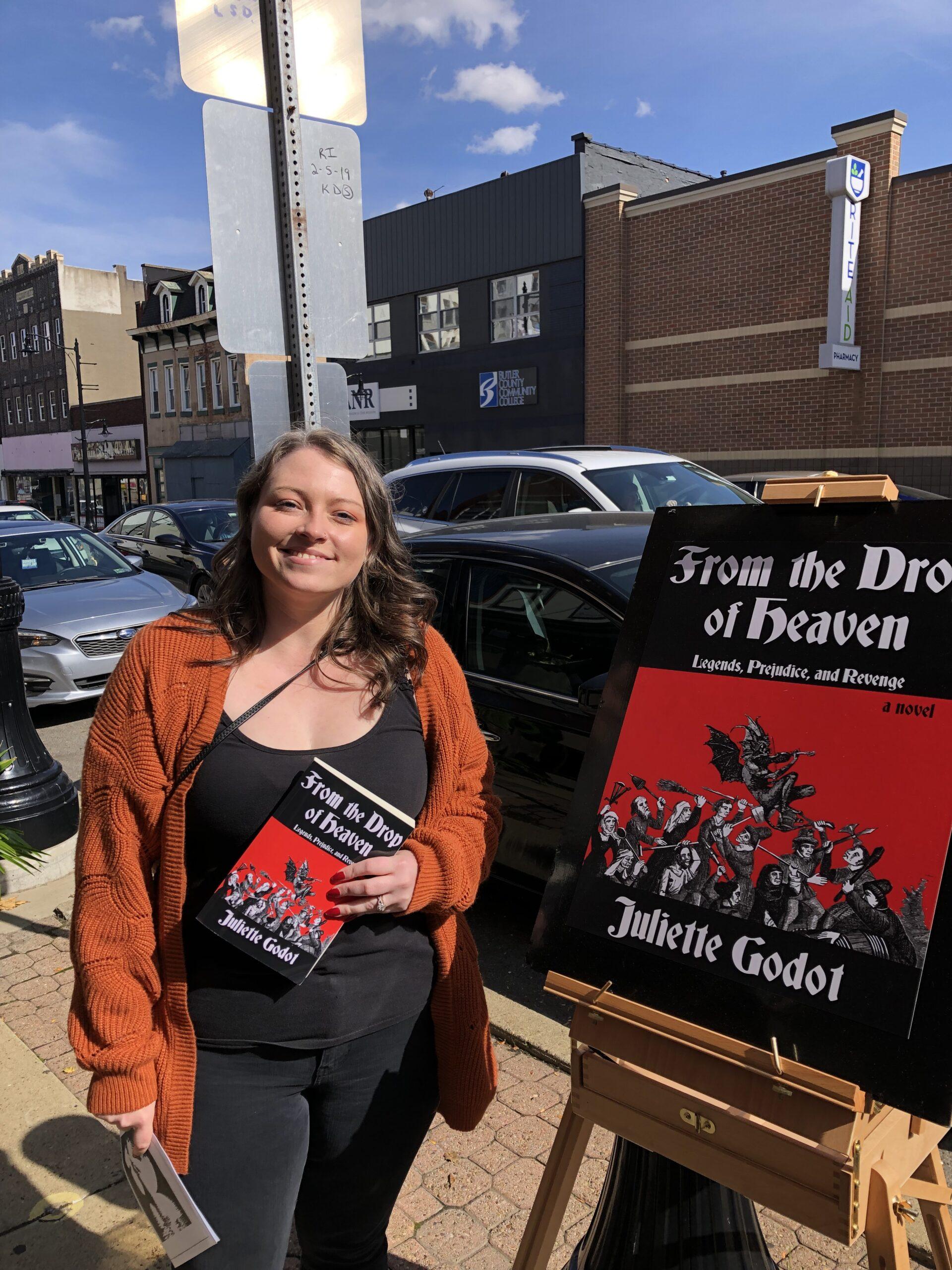
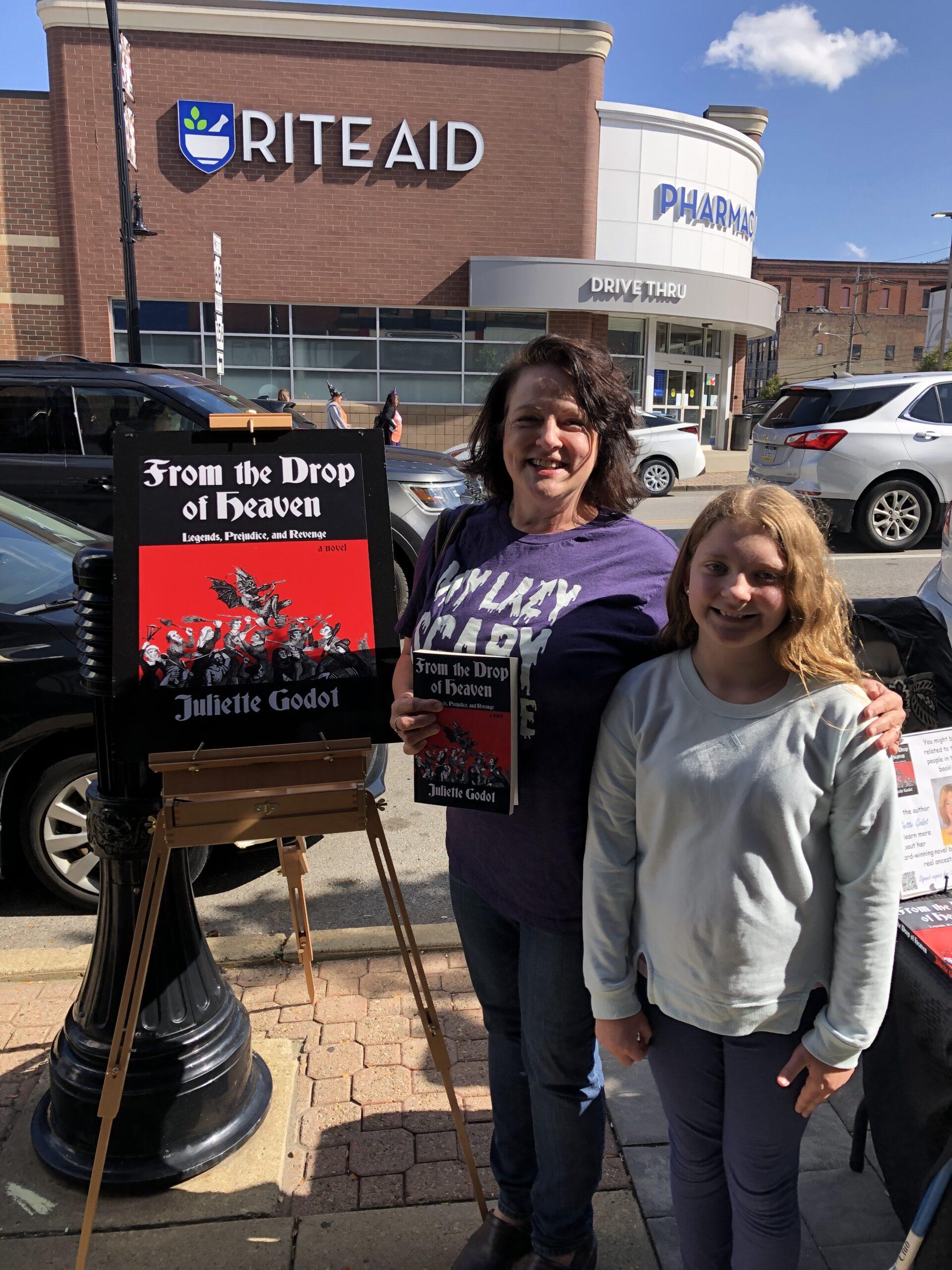
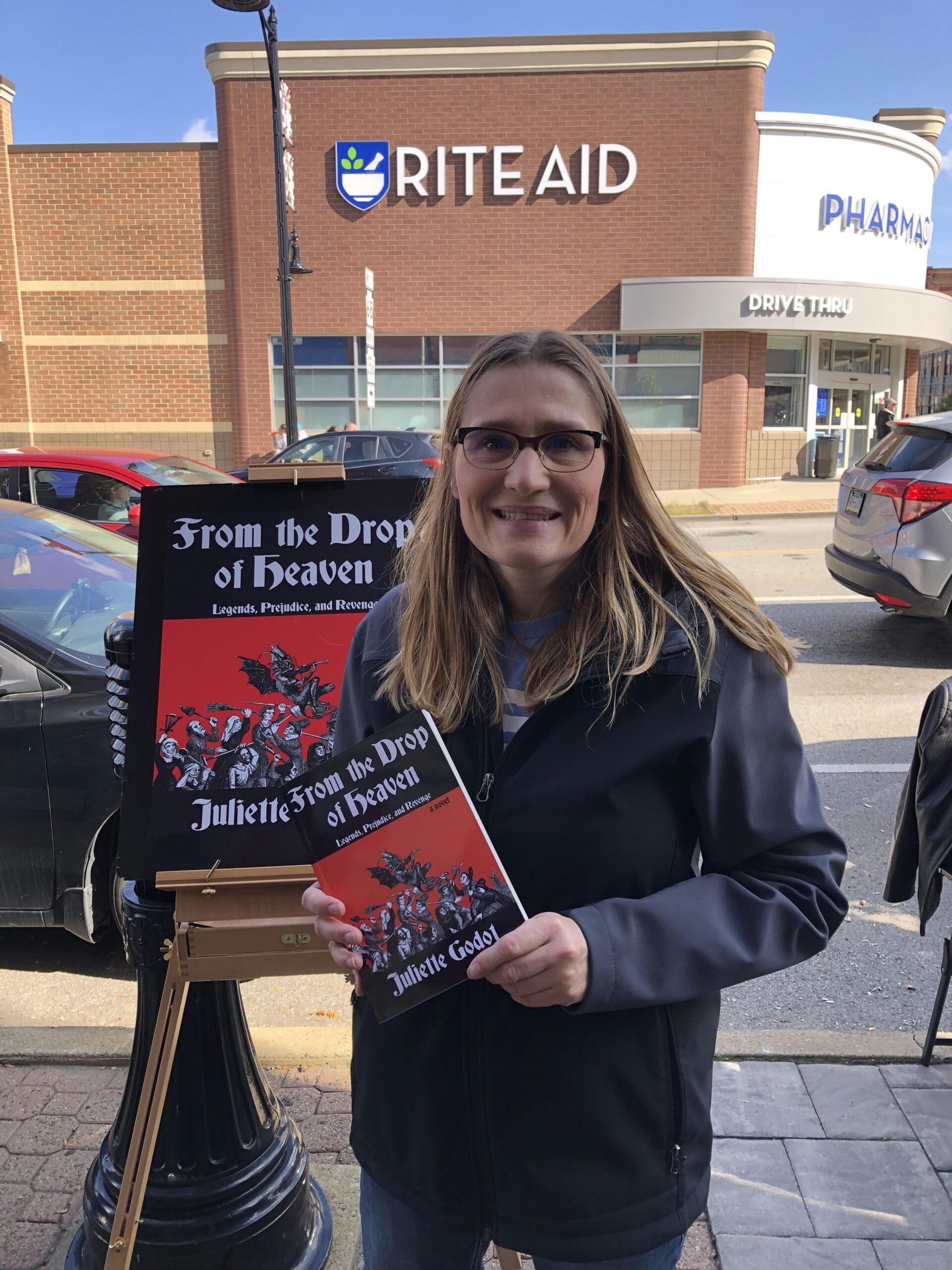
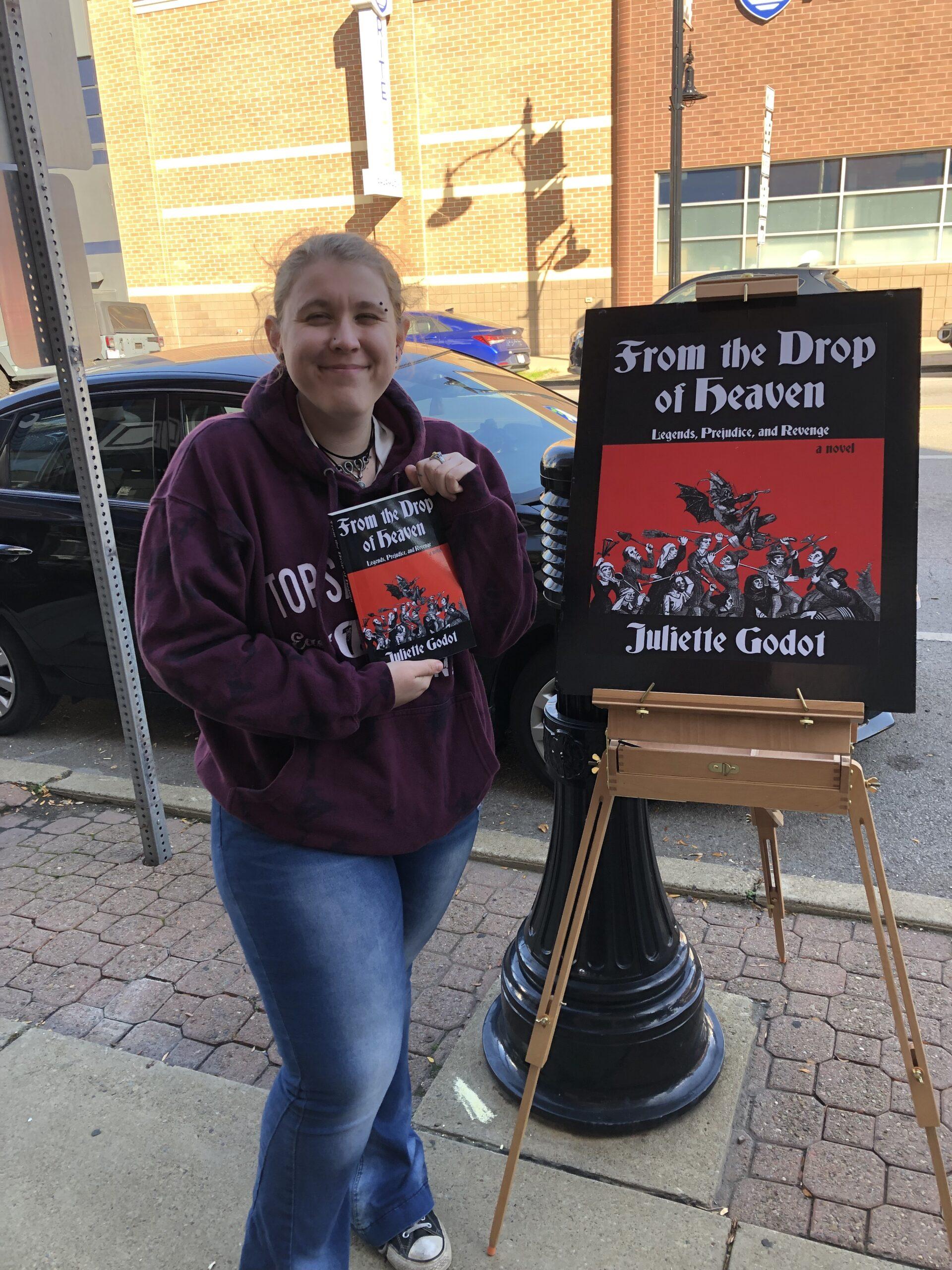
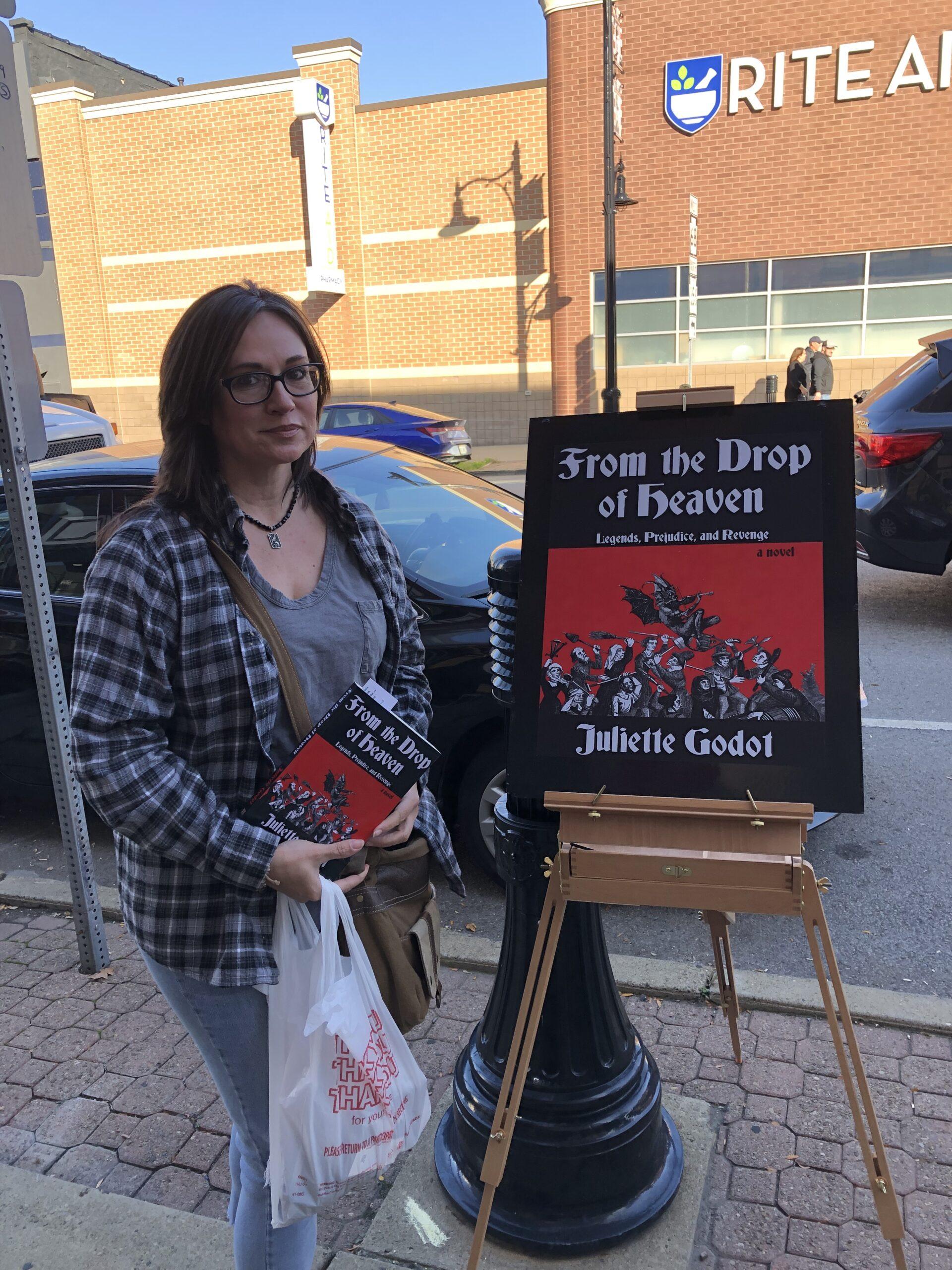
On Saturday, October 15, 2022, our little town held a craft fair and business crawl where all the shops on Main Street were open. My sister and I had a table. She sold her beautiful handmade jewelry, and I held a signing event. (the first photo is me, the rest are some of my lovely customers/ booklovers.)
Signing Event Photos
Juliette Godot at signing event
Booklover at signing event
The weather was gorgeous and I signed 14 books!
Why use a Pen Name?
People have often asked me why I use a pen name and something that happened at this signing event really made me glad that I decided to use one.
At the end of the day, two ladies came to the table and I told them about my book. When I explained that it is about my great-grandmother from 12 generations ago being charged with witchcraft, one of them advised that she and her friend were witches. They cast spells and do divinations. I had never met a real witch, and I was curious. I hate to dismiss anyone because they believe differently than I do, so I spoke with them for a few more minutes before they took their leave and continued down the street. They seemed perfectly normal.
I started packing up my stuff to go home, when another older lady came by and when I began telling her about my book, a weird look came over her face, and she took a step backward. She said witches will come back to life. Unnerved more than a little, and not knowing what to do, I just smiled and told her that my ancestor was not a real witch, but was unjustly charged with witchcraft. The woman said again, louder this time, that witches come back to life before she turned and hurried away… You just never know what someone is thinking!
I turned to my sister who shrugged. The thought of the Hellequin crossed my mind, so we hastily packed up the rest of our stuff so we were sure to be safely at home before dark.
I am excited to announce that my interview with the Historical Novel Society has been posted to their website. It will appear in the next print issue of the Historical Novels Review.
The Historical Novel Society was founded in 1997 as a campaigning society to bring more publicity to the historical novel genre. It has become an international organization for both authors and readers who love Historical Fiction. Anyone can join to learn about new releases and events.
Launch: Juliette Godot’s From The Drop of Heaven
INTERVIEW BY LESLIE S. LOWE
Always the history nerd,Juliette Godot has been working on her genealogy since childhood. Though she never found any royal blood, she did find many noteworthy characters. Juliette spent too many years at a hardware co-op before dropping out of the daily grind and going back to school. Upon graduation, she landed a software engineering position at Carnegie Mellon University and spent the next fifteen years battling deadlines and traffic. By then, she had over 40,000 ancestors cataloged, but she wanted to know more than just names on the family tree.
The quest to find her roots led her to Salm, France, where superstitions were part of everyday life. Juliette was enveloped by the myths and legends of the Renaissance and the grit of the people steadfast in faith as war surrounded them. After winning the 2021 Gold Medal in the Royal Palm Literary Awards for unpublished historical fiction, her debut novel, From the Drop of Heaven, was picked up by Sunbury Press and has just been released.
How would you describe this book and its themes in a couple of sentences?
It’s 1582. Banned books in tow, Martin, an accused seditionist, narrowly escapes the pyre and finds safety with Nicolas’s family. When Nicolas and his love, Catherine, are caught with the books, all three of them are plunged into a fight for their lives. The story is based on my family tree.
What inspired and attracted you to writing historical fiction?
My hobby is genealogy and I found an ancestor with such a shocking life that I couldn’t get her out of my mind. I decided her story needed to be told, but writing historical fiction was much harder than I thought. The research was so fascinating that I kept working on it and came to love it. I traveled to France, took classes on writing and grammar, joined critique groups, and eventually, I finished the book.
Will there be a sequel?
One of my POV characters had an interesting background and her grandson is a minor character in this book. A lot of their backstories landed on the editing floor in a prior version. Both have complex backgrounds and I’ve thought of a twist that I’ve never seen in a novel before.
Does any part of your own life experiences connect with any character or events in the story?
My book is set during the French Renaissance, a period in history when religion ruled the day. Growing up next to my grandparents’ farm, along with my Catholic upbringing, gave me a lot of situations that I could use. I wanted my book to be as true to life as I could make it but I also realize that religion is very personal. I tried to walk the tightrope and not offend anyone.
Is there a key historical event you found in researching that inspired you to write this story to portray a key message?
Yes. My twelfth-generation grandparent’s ancestral record was the inspiration for the book. In fact, the title of the book, From the Drop of Heaven, is the English translation of their name, de la Goutte de Paradis. If I hadn’t found these grandparents, I would never have written a book at all. The message is that though times change, people don’t.
How did you balance the research with writing the story? Is your genealogy search and travel to Salm part of the story or setting of the story?
My cousin whom I had met through genealogy was instrumental in the research. We started writing the book together, but we had different visions for the book. She was a journalist and I was a software engineer with no dreams of writing. She finished her book years ago and self-published it, while I kept writing and rewriting. My husband and I traveled to France to meet her. She showed us the areas of interest in the book from Strasbourg to Nancy, France. We went to the lake, saw the mines and forges, and walked the streets of Vacquenoux. I felt like I was breathing the air that my ancient grandparents breathed. It made all the difference.
How do you think the reader will connect with your characters?
I threw my characters into real situations. They have flaws, biases, insecurities, and dreams. They make mistakes and are the product of their environment and the ideas of the day.
Every author has their own publishing journey. Tell me about yours (process, handling rejection, success).
I literally sent hundreds of queries over the years. I would rewrite the book, send out queries, get rejected, and throw the manuscript in the drawer. After only a couple of months, I was at it again. This went on for many years until I lost all confidence that I would ever finish. Yet, Catherine and Nicolas wouldn’t let me quit. When I joined the Oxford Writing Critique Group, someone suggested that I enter the manuscript in the Florida Writers Association Royal Palm Literary Awards. I only entered because I would get a deep critique of the whole book, which is not something you get from a query letter. I was shocked when I won the Gold Medal for unpublished historical fiction. I am sure that award was the catalyst that made Sunbury Press notice my book.
What advice would you give to other aspiring historical writers?
Don’t give up, but don’t self-publish after you get your first rejections. Make your book the best that it can be. Enter contests, join critique groups, get advice, learn to write, and write it better. It’s a lot harder than people think. Throwing the manuscript in the drawer worked to my advantage because I realized where the story had holes when I read it months later.
What is the last great book you read?
I just finished Cold Blows the Wind by Anne Meyrick.
Soapwort grew for years along the edge of the woods behind my house, and though I always loved the burst of color and sweet smell, I never knew its practical value used for soap making.
While Marie did not know how phosphates suspend oil and dirt in water to be rinsed away, she knew that boiling soapwort created foam that would accomplish the same task.
Long before lye and fragrance oils filled modern soap kitchens, our ancestors turned to the wild hillsides and sparsely wooded areas for a gentler kind of clean. One of the oldest natural soap alternatives, soapwort (Saponaria officinalis), was cherished for its sudsy roots and leaves—used to wash delicate fabrics, cleanse skin, and even restore old paintings.
Today, soapwort offers a simple, non-toxic way to make soap at home. Unlike cold-process soapmaking, which involves lye and fat, soapwort soap is a botanical infusion—perfect for sensitive skin, historic reenactments, or anyone looking to reconnect with earth-based traditions.
Sweet William
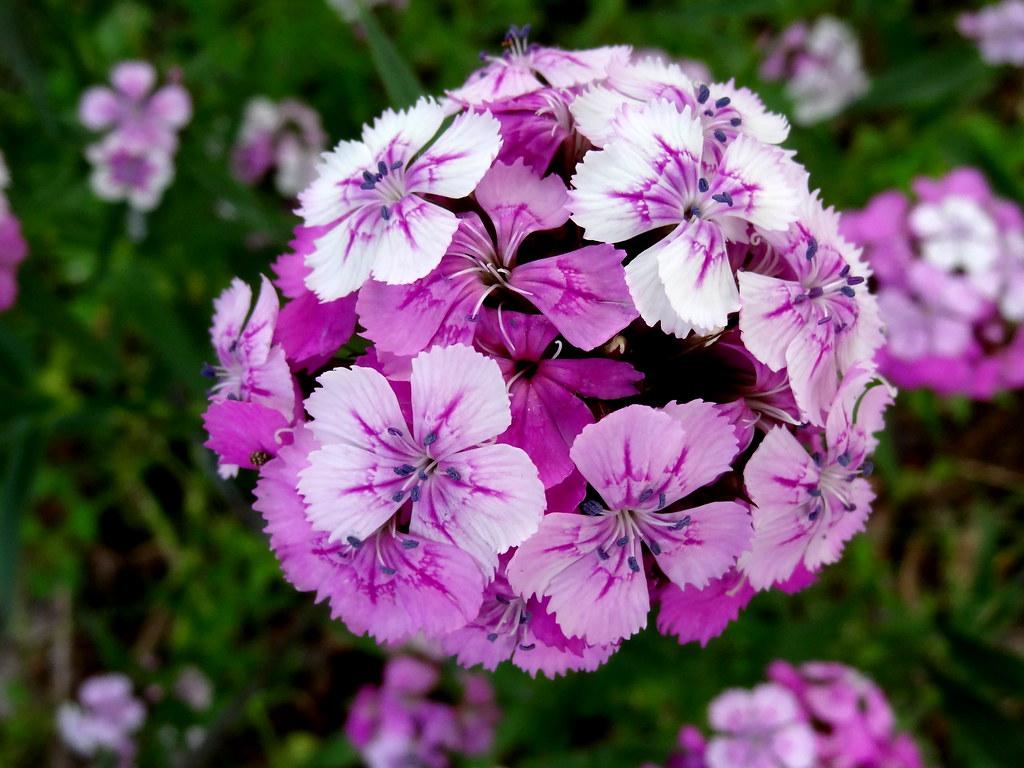
Sweet William grows in early summer in the rich, well-drained soil along the edge of the meadow where it is shaded from the strong afternoon sun. The leaves are slightly hairy with flowers forming atop the smooth stem. Little fingers appear to reach out from the stem and grab weeds near it to reach its full height of three feet. Left undisturbed, it can be invasive. The prolific pink, sometimes white, flowers burst forth from June to October attracting butterflies and honeybees with their sweet, spicy aroma.
This natural soap is gentle enough for use on wool sweaters or silk blouses without stripping their natural oils. The cleanser made from soapwort makes a nice alternative for sensitive skin or an herbal bath. Leftovers keep better in the refrigerator. If you cannot use it within the week, freeze it to avoid bacterial growth.
To verify wild sweet william, pick a handful of leaves and flowers, dunk them in a bucket of water, and rub them vigorously between your palms. A cool green lather will form with a fresh outdoorsy scent.
Soap Making
Instructions:
In the spring, harvest the shallow woody rhizomes, scrub them, and cut them into small chunks. Prepare the plant: Chop the roots (or leaves if you’re using them instead). Fresh or dried both work—roots produce more lather, leaves offer a milder wash.
Place two handfuls into a quart of boiling water. Return to a boil, and then lower the heat and let simmer for about twenty minutes. Once the mixture cools, run it through the blender, a little at a time. This will create a lot of foam, so allow it to dissolve overnight. Strain the mixture through a sieve to remove the bits of roots. Dry and store these bits to toss in the pot the next time.
Bottle and store: Keep it in a glass jar in the fridge for up to a week, or freeze in ice cube trays for longer storage. Shake gently before each use.
To use all year long, dry the leaves, flowers, and roots, making sure to turn frequently to avoid mold growth.
As with any soap, do not eat soapwort.
Notes from the Past
Soapwort’s lather is mild but effective—perfect for handwashing lace, wool, or your face. In medieval monasteries and early American settlements, it was a trusted ally for both the washbasin and the apothecary. While it won’t foam like commercial soaps, its silky texture and earthy scent remind us that clean doesn’t have to mean chemical.
Of the myriad of species collected, Francisca relied on Hemp-Agrimony above all others, collecting the leaves and flowering tops in August before they opened and dried.
Vitamin C in plants such as Hemp-Agrimony staved off scurvy and colds during the long Vosges winter without fresh fruits.
A tea made from Hemp-Agrimony leaves or dried flowers is a natural cure for colds and sore throats, reduced fever, and relieved stomachaches. The bruised leaves applied directly to the skin healed wounds or infections or rubbed on domestic animals repelled insects. Placing the leaves in a bath relieves aching muscles and joints and compress of the leaves relieves headaches. Even the roots from the plant were used as a laxative.
To harvest, wear long pants and boots as it is found in wet soil near swamps and thickets or along freshwater streams, the same place snakes like to inhabit.
Hemp-Agrimony is a tall woody plant, growing between two and five feet high with long, toothy leaflets. The leaves grow in familiar tiered hemp-style in pairs of three lobes. Reddish stems covered in downy hair with clusters of tiny pink or white flowers that burst forth from July to September.
Hemp-Agrimony is no relation to Agrimony, a plant with yellow flowers, nor is it related to Cannabis Hemp, though the shape of the leaf is similar.
PLEASE NOTE: All parts of the plant are poisonous if eaten and should only be ingested as tea.
Source: Weiner, Michael A., Earth Medicine, Earth Food. MacMillan Publishing Co, Inc. (1980) Print
People have used ginger for thousands of years to expel toxins in the body. Ginger’s natural anti-inflammatory properties will soothe your throat and warm your body to chase colds away. You need about a two-inch piece of ginger root. Peel and thinly slice and add to about four cups of water. Allow to simmer for about 15-20 minutes, and then strain into a mug. Ginger is naturally sweet, so taste before adding anything additional, but a squeeze of lemon, cinnamon, and honey also adds flavor and benefits.
Sources:
Weiner, Michael A., Earth Medicine, Earth Food. MacMillan Publishing Co, Inc. (1980) Print https://www.naturalnews.com/042226_common_cold_natural_remedies_apple_cider_vinegar.html
I am reposting a photo of my Royal Palm Literary Award because it is pretty and because I truly believe that without it, I wouldn’t have gotten a contract. Yippee!!
When I was a child, we would put out our stockings on December 5, hoping Saint Nicholas would bring us a small toy in anticipation of Christmas. Besides getting a gift, I had never given much thought to the actual Saint called Nicolas, or why we celebrated this “small Christmas” weeks before the real one. Eventually, my parents stopped reminding us to put out our stockings, and the entire holy day got wrapped into Christmas.
There are many stories about Saint Nicholas, most written hundreds of years after his death. He is said to have been born wealthy but gave up his life of luxury for a life of service. In one of his most famous acts of kindness, he is said to have saved three girls from being sold into prostitution by dropping gold coins through their window each night for three nights so their father could afford a dowry for them. Nicholas is attributed to saving three innocent soldiers from execution and also for chopping down a tree that had been possessed by a demon.
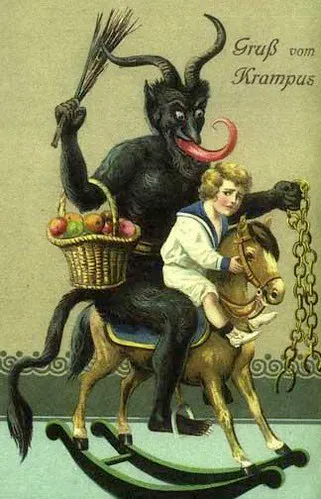
But a legend of Saint Nicholas Day that I had never heard of, was that of Krampus. When I began researching legends of the Vosges for the book, I came across this sidekick of Saint Nicholas. I thought I would write about him to bring another legend of the Vosges to light.
Krampus began as a pagan celebration. He is said to be the son of Hel from Norse mythology but became wrapped into the Christian tradition of Christmas.
So, if you are reading this on December 6, Nikaustag, Saint Nicholas Day, that means that you have been good and Krampus did not eat you the night before. Kinda scary for a child’s story, but …whatever…
“Gruß vom Krampus: Greetings from the Krampus: Happy Christmas? by Artist unknown” by dullhunk is marked with CC BY 2.0.
According to the legend, a half-goat, half demonlike creature with long curly horns, a forked tongue, and a furry black body named Krampus, would arrive on December 5, Krampusnacht or Krampus Night. He would chase both children and adults through town, poking them with sticks if they were naughty. Particularly, disobedient children would be visited that night, and depending upon the severity of the misbehavior, would either be eaten or would be given coal.
Happy Krampus Night and Happy Nicholas Day tomorrow!
Between Yule and Twelfth Night, whilst the dead still walk among the living as they usually do during these thinly veiled times; beware the deep of the night. Be sure to leave the final sheaf of wheat in the field and do not remove the feast from the table to allow the ancestral spirits to come and collect their portion, else, the household of Hellequin will collect their share of souls.